

The incredible rise of live, at-home strength classes has democratized fitness. Thousands of people who previously felt intimidated by the commercial gym environment are now lifting heavy weights and transforming their bodies in their living rooms. This is an unequivocally fantastic shift.
However, this convenience introduces a significant new challenge. In a physical gym, a coach can walk behind you and physically correct your posture before you lift a heavy barbell. During a live class, while the instructor is demonstrating perfect form on the screen, you are largely responsible for self-correcting in your own space.
When the music is blaring, the instructor is shouting motivation, and you are exhausted in the final ten minutes of a class, form is almost always the very first thing to deteriorate. Today, we are going to dive into the vital importance of biomechanics and discuss exactly how you can protect your spine, your knees, and your shoulders from injury during fast-paced live strength classes.
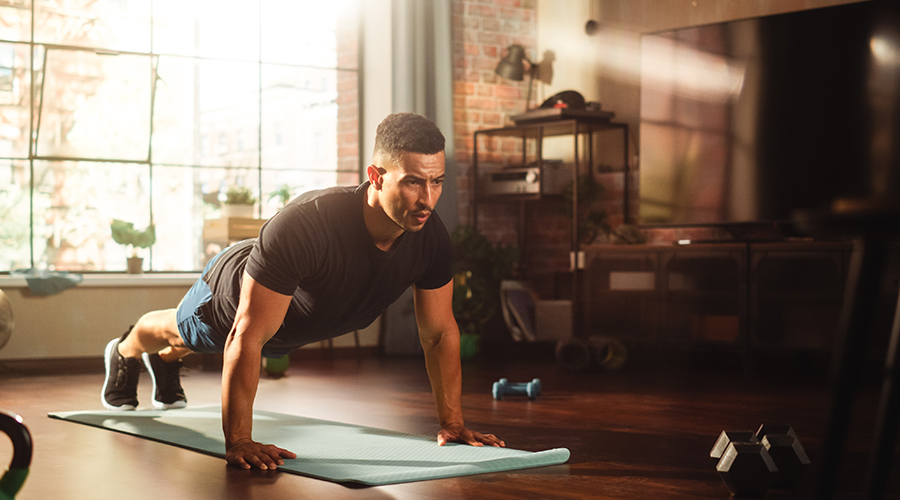
Why "Just Getting the Rep" is Dangerous
In fitness, there is a concept known as the "Path of Least Resistance." The human body is incredibly clever. If you instruct it to move a 30-pound dumbbell from point A to point B, your nervous system will attempt to accomplish that task using the absolute easiest mechanical pathway possible.
If your bicep is too weak to curl the dumbbell strictly, your body doesn't just give up. Instead, it recruits your lower back to aggressively swing the weight upward, utilizing momentum. You successfully moved the weight from point A to point B. The instructor calls out "Great job, one more rep!"
But structurally, this is a disaster. You completely removed the tension from the target muscle (the bicep, meaning it will not grow) and shifted violent, uncontrolled shearing forces directly into your lumbar spine (greatly increasing your chance of a herniated disc).
The Golden Rule of Strength Training: You are never simply moving a weight. You are forcing a specific, isolated muscle group to overcome resistance. If the target muscle cannot do the work alone, the set is officially over.
The Unholy Trinity: The 3 Most Dangerous Form Breaks
As coaches who watch hundreds of athletes move, we consistently see the same three major form breakdowns occur when fatigue sets in during a live class. Memorize these, and actively scan for them during your next workout.
1. Spinal Flexion During Hinge Movements (The "Dogfish" Back)
Where it happens: Deadlifts, Romanian Deadlifts (RDLs), Kettlebell Swings, Bent-Over Rows.
The Mistake: As the hamstrings get tired, athletes stop pushing their hips backward (hinging) and start bending forward at the waist. The spine aggressively rounds forward like a frightened cat.
The Fix: Imagine a wooden broomstick pressed rigidly against three points: the back of your head, between your shoulder blades, and on your tailbone. All three points must maintain contact throughout the entire descent. If your lower back rounds, you have gone too deep. Stop your descent the exact moment your hamstrings feel tight.
2. Knee Valgus During Deep Flexion (The "Cave In")
Where it happens: Squats, Lunges, Box Jumps, Landing mechanics.
The Mistake: When pushing forcefully out of the bottom of a heavy squat, the knees buckle violently inward toward each other. This places catastrophic lateral strain on the ACL and MCL ligaments of the knee.
The Fix: Weak glute medius muscles are usually the culprit. As you lower into a squat, actively twist your feet into the floor (as if you are trying to rip a towel in half between your feet). Actively think "knees OUT" during the entire upward pressing phase. If they cave, the weight is too heavy.
3. Flared Elbows During Horizontal Pressing
Where it happens: Push-ups, Dumbbell Bench Press, Floor Press.
The Mistake: Flaring the elbows straight out horizontally so that the arms and torso form a rigid "T" shape at the bottom of the movement. This shifts the internal load off the powerful chest muscles directly onto the fragile rotator cuff tendons.
The Fix: Tuck your elbows. Your body and your arms should look like an arrow pointing forward, roughly a 45-degree angle from your torso. This optimally engages the pectorals and keeps the shoulder joint in a safely packed, stable position.
How to Self-Correct in Real-Time
You know what to look for, but how do you actually implement these corrections when the clock is ticking down and the instructor says "10 seconds left!"?
Adopt the "First Rep Rule"
The very first rep of any new set must be performed slowly and methodically, serving as a diagnostic check for your entire body. Do not rush into a frantic pace just because the music dropped. Lock in the form on rep one, verify it feels correct, and then gradually increase the speed.
Use a Mirror or Your Camera
You cannot correct what you cannot see. If you do not have a full-length mirror, prop your phone against a water bottle and use the front-facing camera as a live feed. Compare your spine angle directly to the instructor on the screen.
Embrace the Drop Set
If you are supposed to perform bicep curls for 45 seconds, and your form breaks completely at 30 seconds, drop the weights instantly. Continuing with terrible form is useless. Pick up a lighter pair of dumbbells immediately, or finish the remaining 15 seconds doing the motion with just your body weight, intensely flexing the muscle.
The Bottom Line
Intensity is incredible, but intensity applied to dysfunctional movement invariably leads to orthopedic surgeons. During your next live class, explicitly divorce your ego from the weight you are holding. Strive for absolute technical perfection. A lighter weight moved with flawless, controlled biomechanics will always build more tissue and burn more fat than a heavy weight moved dangerously. Make every single rep beautiful.
Want Real-Time Form Correction?
Working out at home shouldn't mean sacrificing professional oversight. In our two-way interactive live classes, our coaches can actually see you. We provide gentle, real-time verbal form cues to ensure you are moving perfectly, safely, and powerfully every single session.
Experience Interactive Coaching