
Walk into any gym, and you will see the exact same phenomenon: people doing the same exercises, with the same weight, for the same number of repetitions, day after day, month after month. Fast forward a year, and their bodies look exactly the same. They are undeniably putting in the hard work and sweating profusely, yet they are completely stuck on a frustrating plateau.
Why does this happen? Because they are missing the single most crucial law of human physiology when it comes to changing body composition. It doesn't matter what supplements you take, what trendy new workout program you bought, or how perfectly clean your diet is. If you are not actively applying the principle of Progressive Overload, you will not build new muscle. Period.
Today, we are going to dive deep into exactly what progressive overload is, the fascinating science behind why our muscles require it to grow, and how you can seamlessly implement it into your routine starting with your very next workout.
The Science: Why Muscles Grow
To understand progressive overload, we must first understand why the human body bothers to build muscle in the first place. The human body is an incredibly efficient survival machine. Muscle tissue is metabolically expensive; it requires a lot of calories just to maintain. Therefore, your body will absolutely refuse to build or keep muscle mass unless it feels it has a distinct survival reason to do so.
When you lift a weight that is challenging, you create micro-tears in the muscle fibers. In the fitness world, we call this a stimulus. Your body interprets this stimulus as a physical threat. It thinks, "Wow, I was barely strong enough to lift that object. I need to rebuild these damaged fibers not just to their previous state, but slightly stronger and larger so that the next time I encounter this threat, I am prepared."
This rebuilding process (which happens while you rest and eat protein) is called Muscular Hypertrophy.
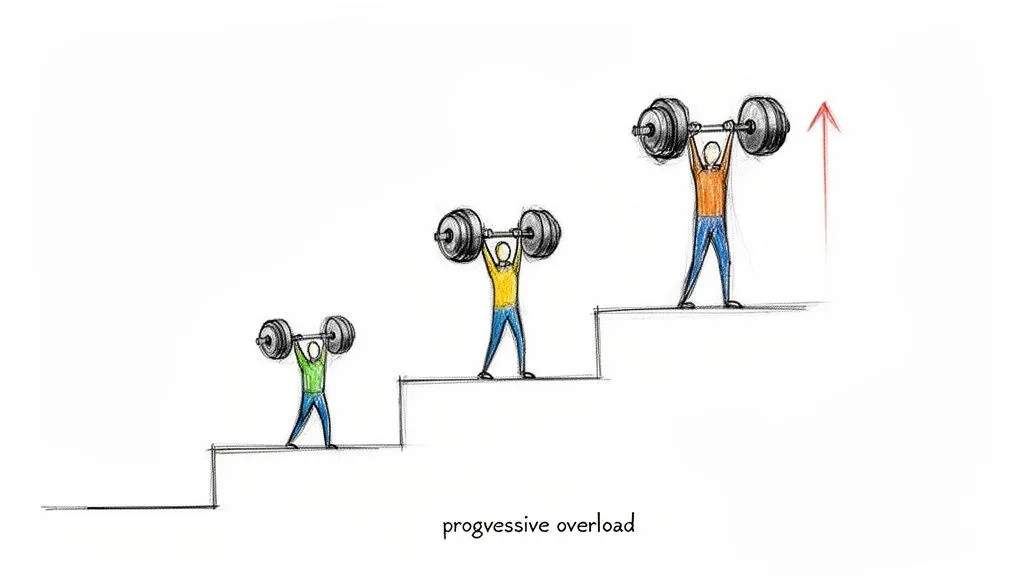
But here is the catch: once your body has rebuilt the muscle to be strong enough to lift that specific 15-pound dumbbell for 10 reps, it stops adapting. Lifting that same 15-pound dumbbell for 10 reps is no longer a "threat." It is now the baseline. If you want the muscle to grow again, you must introduce a new, greater threat. You must progressively overload the system.
4 Ways to Apply Progressive Overload
The most common misconception is that progressive overload simply means "adding more weight to the bar." While increasing the physical load is the most straightforward method, it is certainly not the only way, and for beginners or those working out at home, it is often not the most practical.
Here are four highly effective ways to force your muscles to adapt and grow without necessarily buying heavier weights:
1. Increase the Resistance (Weight)
This is the classic method. If you successfully completed 3 sets of 10 squats holding a 20-pound kettlebell this week, next week your goal is to hold a 25-pound kettlebell for those same 3 sets of 10. The increased mechanical tension forces new adaptation.
2. Increase the Volume (Reps and Sets)
If you are working out at home and simply do not have a heavier dumbbell, you can still achieve progressive overload by doing more visual work. If your max was 10 push-ups last week, fighting for 11 push-ups this week is progressive overload. Moving from 3 total sets of an exercise to 4 total sets is also progressive overload.
3. Decrease the Rest Time
Doing the exact same amount of work but in less total time forces incredible metabolic adaptation. If you normally rest for 90 seconds between heavy lunges, try resting for only 60 seconds next week. Your muscles have less time to clear lactic acid and replenish ATP, making the identical weight feel significantly harder.
4. Manipulate The Tempo (Time Under Tension)
This is the silent killer and the best-kept secret of bodybuilders. Try taking 4 full, agonizingly slow seconds to lower yourself into a squat, pausing for an entire second at the very bottom, and then exploding up. A 10-pound weight moving at this ultra-slow tempo will stimulate more muscle growth than a 30-pound weight being bounced around with momentum.
The Golden Rule: Form Over Everything
As you aggressively chase progressive overload, there is one non-negotiable caveat: the form must remain identical.
If you go from curling 20-pound dumbbells with perfectly strict form, to curling 30-pound dumbbells by violently swinging your back and using momentum, you did not achieve progressive overload in your biceps. You simply recruited other muscles to cheat. Worse, you drastically multiplied your risk of a lower back injury.
The Benchmark:
Progressive overload only counts if the target muscle is doing the exact same mechanical work as before, just harder. Never sacrifice your joint health for an extra rep on the logbook.
How to Track Your Progress (The Logbook Method)
You cannot manage what you do not measure. Going to the gym and guessing what you lifted last week is a recipe for stagnation. You must keep a logbook.
Step 1: Write it Down
Whether it is a physical notebook, the notes app on your phone, or a dedicated fitness app, immediately record the exercise, the weight used, and the exact number of reps performed for every single set.
Step 2: Establish the "Double Progression" Model
Pick a rep range, for example, 8 to 12 reps. Stay with a specific weight until you can easily perform 3 sets of 12 reps with perfect form. Once you hit the top of the rep range (12), increase the weight slightly. Your reps will naturally drop back down to 8 or 9. Slowly build back up to 12. Repeat forever.
Step 3: Accept Non-Linear Progress
You will not add 5 pounds to the bar every single week for the rest of your life. Sleep, nutrition, and stress all play huge factors. Some weeks, tying your previous record is a massive victory. Strive for an upward trend over months, not days.
The Bottom Line
Muscles are stubborn. They do not want to grow unless they are absolutely forced to. By diligently applying the principles of progressive overload—whether through heavier weights, more reps, tighter rest periods, or agonizingly slow tempos—you mandate growth. Stop going through the motions. Start logging your workouts, treating every session as a chance to beat your past self, and watch your body finally transform.
Let Us Program the Overload for You
Trying to calculate progressive overload on your own can be confusing and lead to plateaus. In our dedicated live strength series, our expert coaches build progressive overload directly into the programming week over week, guaranteeing you get stronger safely.
Explore Live Strength Classes